
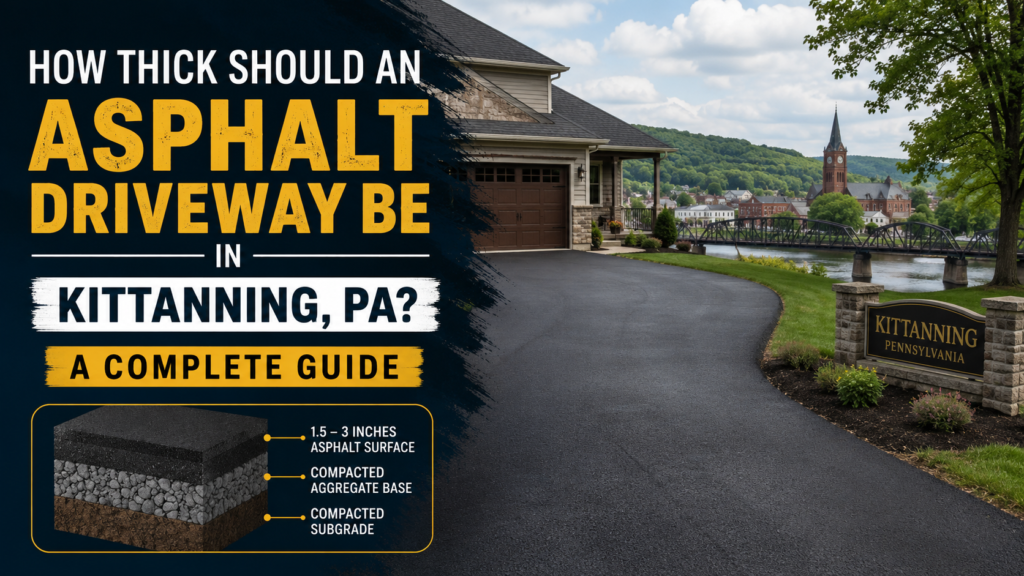
When homeowners in Kittanning, Pennsylvania plan a new asphalt driveway, one of the most important technical decisions and one that is frequently misunderstood or inadequately addressed is the question of thickness. How thick does the asphalt need to be? How much base is required beneath it? Does the answer change based on what vehicles will use the driveway? These are not abstract questions for Western Pennsylvania property owners. Armstrong County’s freeze-thaw cycles, clay soils, and rainfall make pavement thickness a genuine factor in how long a driveway lasts. Getting this right from the start protects the investment; getting it wrong produces cracking and failure that cannot be corrected without rebuilding from the ground up.
Understanding the Pavement Structure: More Than Just Asphalt
Before addressing thickness specifications, it is important to understand that an Asphalt Driveway Thickness Kittanning is not simply a layer of black material on the ground. It is a multi-layer system, and the behavior of each layer affects the performance of the entire structure. The standard residential driveway cross-section from bottom to top consists of:
- Sub-grade: The native soil beneath the driveway. This is not a constructed layer it is what is there when all the organic material and topsoil are removed. The sub-grade’s bearing capacity its ability to support loads without deflecting determines how much base material is needed above it.
- Sub-base (optional): In areas with very poor sub-grade conditions soft clay, organic soil, high water table an additional coarse aggregate layer may be placed to improve drainage and load distribution before the base course is installed.
- Aggregate base course: A layer of crushed stone (typically limestone quarried locally in Armstrong County or from nearby sources) that is spread and compacted to provide structural support, load distribution, and internal drainage. This is the most important structural layer in the pavement system the aggregate base does more work to support the driveway than the asphalt surface layer does.
- Asphalt surface course: The hot mix asphalt layer (or layers) that forms the driving and parking surface. This layer provides the waterproof seal that protects the base and sub-grade from moisture infiltration, distributes vehicle loads over a wider area of the base, and provides the smooth, durable surface that we associate with paved driveways.
Recommended Asphalt Thickness for Kittanning Residential Driveways
For standard residential driveways in Kittanning serving passenger vehicles cars, SUVs, and light pickup trucks the industry standard and PennDOT-aligned recommendation is:
- Asphalt surface layer: 2.5 to 3 inches of compacted hot mix asphalt. The important word here is “compacted” asphalt is installed at approximately 1.2 to 1.3 times the desired compacted thickness to account for the compression that roller compaction achieves. A contractor specifying 3 inches of compacted asphalt will install approximately 3.5 to 4 inches of loose material before rolling.
- Aggregate base course: 6 to 8 inches of compacted quarry process aggregate (also called crusher run, QP, or AASHTO 2A in PennDOT terminology). Six inches is the minimum; 8 inches is appropriate when the sub-grade is clay or has marginal bearing capacity which describes a significant portion of Kittanning’s residential sub-grades.
The total structural depth from the compacted asphalt surface down to the undisturbed sub-grade should therefore be approximately 9 to 11 inches on a typical Kittanning residential driveway. Properties where excavation reveals poor or soft sub-grade should use deeper base courses.
Why Pennsylvania’s Climate Demands Adequate Thickness
In some climates, a 2-inch asphalt layer over a minimal base can perform adequately for light residential use. Kittanning is not one of those climates. The freeze-thaw cycling that characterizes Armstrong County winters makes adequate thickness not a luxury but a necessity:
- Thin asphalt is more susceptible to thermal cracking: When temperatures drop well below freezing as they regularly do in Kittanning’s winters asphalt becomes stiff and brittle. Thermal contraction under these conditions can cause cracking across the surface, particularly in thinner pavements that have less mass to resist contraction forces. Adequate thickness (3 inches rather than 2) reduces this risk.
- Thin bases fail faster under frost heave: When the ground freezes, ice lenses form in the soil and aggregate, causing upward movement (frost heave) that can displace pavement sections. Adequate base depth and proper drainage keeping the base as dry as possible reduce the water available for ice lens formation and limit frost heave damage. Thin bases with poor drainage are particularly vulnerable.
- Load distribution requires adequate depth: The aggregate base distributes vehicle loads over a wider area of sub-grade, reducing the stress at any given point to within the sub-grade’s bearing capacity. Thicker bases distribute loads more effectively, protecting clay sub-grades that have limited load-bearing strength when wet.
Driveways That Need More Than Standard Thickness
Not every Kittanning residential driveway should be built to the standard residential specification. Several situations call for greater thickness:
- RVs, large pickup trucks, or farm equipment: Heavier vehicles require more structural capacity. A driveway that will regularly support a loaded dump truck, a recreational vehicle, or a large tractor should have a minimum of 3.5 to 4 inches of compacted asphalt surface and 8 to 10 inches of aggregate base.
- Poor sub-grade conditions: If excavation reveals very soft clay, organic material, or a high water table that cannot be fully mitigated, compensating with additional base depth is the appropriate response. An extra 2 to 4 inches of aggregate base on a poor sub-grade can dramatically extend driveway life.
- Steep grades: Driveways on steep Armstrong County hillsides experience higher shear stress from braking and acceleration, which can damage undersized pavement. Slightly additional asphalt thickness (3.5 inches rather than 3) on steep grades improves resistance to this surface stress.
- High-traffic applications: Driveways that function more like commercial surfaces serving delivery vehicles daily, accessing business operations, or providing turnaround for commercial equipment should be built to light commercial specifications: 4 inches of asphalt over 8 to 10 inches of base.
The Two-Lift Installation Approach
For driveways on the larger end of the residential scale long driveways, driveways with significant grades, or driveways serving heavier-than-average vehicles experienced Kittanning contractors often install asphalt in two separate lifts (layers) rather than a single lift:
- Binder course: A first lift of 2 inches (or more) of a coarser asphalt mix that provides structural depth. This layer is installed and compacted before the surface layer is applied.
- Surface course: A second lift of 1.5 to 2 inches of a finer asphalt mix that provides the smooth, dense wearing surface.
Two-lift construction produces a better-performing driveway than a single thick lift because each layer can be compacted independently to the correct density. It is also the standard construction method for commercial parking lots and roads. For premium residential driveways in Kittanning, this approach is worth the additional planning it requires.
How Sub-Grade Condition Determines Base Thickness
The relationship between sub-grade condition and required base thickness is direct and important for Kittanning homeowners to understand. A strong, well-draining sub-grade (sandy or gravelly soil) requires less base to achieve the same structural performance as a weak, poorly draining sub-grade (heavy clay). In a simplified form, the rule is: the worse the sub-grade, the thicker the base needs to be.
Armstrong County’s soils particularly in valley locations near the Allegheny River and its tributaries often include significant clay content. When a contractor’s excavation reveals clay sub-grade, the appropriate response is not to simply install the minimum specified base thickness and proceed. It is to evaluate the clay’s condition (wet clay is weaker than dry clay), consider adding 2 to 4 inches of additional base depth, consider the installation of drainage measures to reduce future moisture in the base and sub-grade, and potentially use geotextile fabric to separate the aggregate base from the clay sub-grade and prevent clay migration into the base voids over time.
Verifying Thickness: What Property Owners Should Know
After a driveway is installed, how can a homeowner verify that the thickness is what was specified? The most practical approach is to discuss thickness specifications before installation begins, obtaining a written scope of work that specifies the compacted asphalt thickness and base depth. During installation, a property owner can request to observe the base compaction before asphalt is applied, which gives a visual sense of the base depth and condition. After installation, core samples extracted with a hollow drill bit can be sent to a testing lab to verify both the asphalt thickness and its density. While most homeowners do not pursue core sampling for standard driveways, it is an option when a significant discrepancy is suspected.
Conclusion
The right asphalt driveway thickness for Kittanning, Pennsylvania is not a single number it depends on the intended use, the sub-grade conditions, and the specific site characteristics. For standard residential driveways on moderate sub-grades, 2.5 to 3 inches of compacted asphalt over 6 to 8 inches of aggregate base represents the appropriate specification for Armstrong County’s demanding climate. Heavier use, poorer sub-grades, and steeper grades all call for more. Understanding these specifications and confirming that your contractor plans to meet them is the most important step a Kittanning homeowner can take toward a driveway that performs reliably through Western Pennsylvania’s challenging seasons.